In the world of online retail, e-commerce fulfillment is a crucial factor for the success of DTC brands. We explain everything important about the topic of e-commerce fulfillment and what advantages come with it for your success.


Many benefits arise from the e-commerce fulfillment definition.
Working with a fulfillment service provider offers several advantages for e-commerce brands.
The concrete benefits are:

Relief from warehouse and logistics tasks: By outsourcing storage and shipping to a fulfillment service provider, you can focus your limited time and resources on other aspects of your business.

Scalability: Since fulfillment service providers can efficiently scale the order processing process in e-commerce, you can grow with ease without worrying about logistical challenges.

Cost savings: You can benefit from cost savings that result from working with a fulfillment service provider, such as reduced warehouse and shipping costs, higher productivity through automation, or avoiding the purchase of warehouse management software, shelving, and recruiting operational staff.

Customer experience – with WOW factor: Your fulfillment partner should offer 1-day shipping, branded packaging, and a returns portal. This allows you to enhance the customer experience by processing and delivering orders quickly and precisely, and making the unboxing experience a unique moment and part of your brand identity.

Returns management: Fulfillment service providers should also offer your customers an easy way to return your products. You should be able to manage the returns process clearly so you can initiate refunds or reshipping as easily as possible.

International expansion: By working with a fulfillment service provider that offers global shipping options, you can expand your reach and enter new markets. You can typically benefit from favorable shipping rates and direct shipping routes to your target markets.

Integration into existing systems: Your logistics partner should offer native integrations into existing e-commerce platforms and systems, which further simplifies the setup and workflow of order processing in e-commerce.


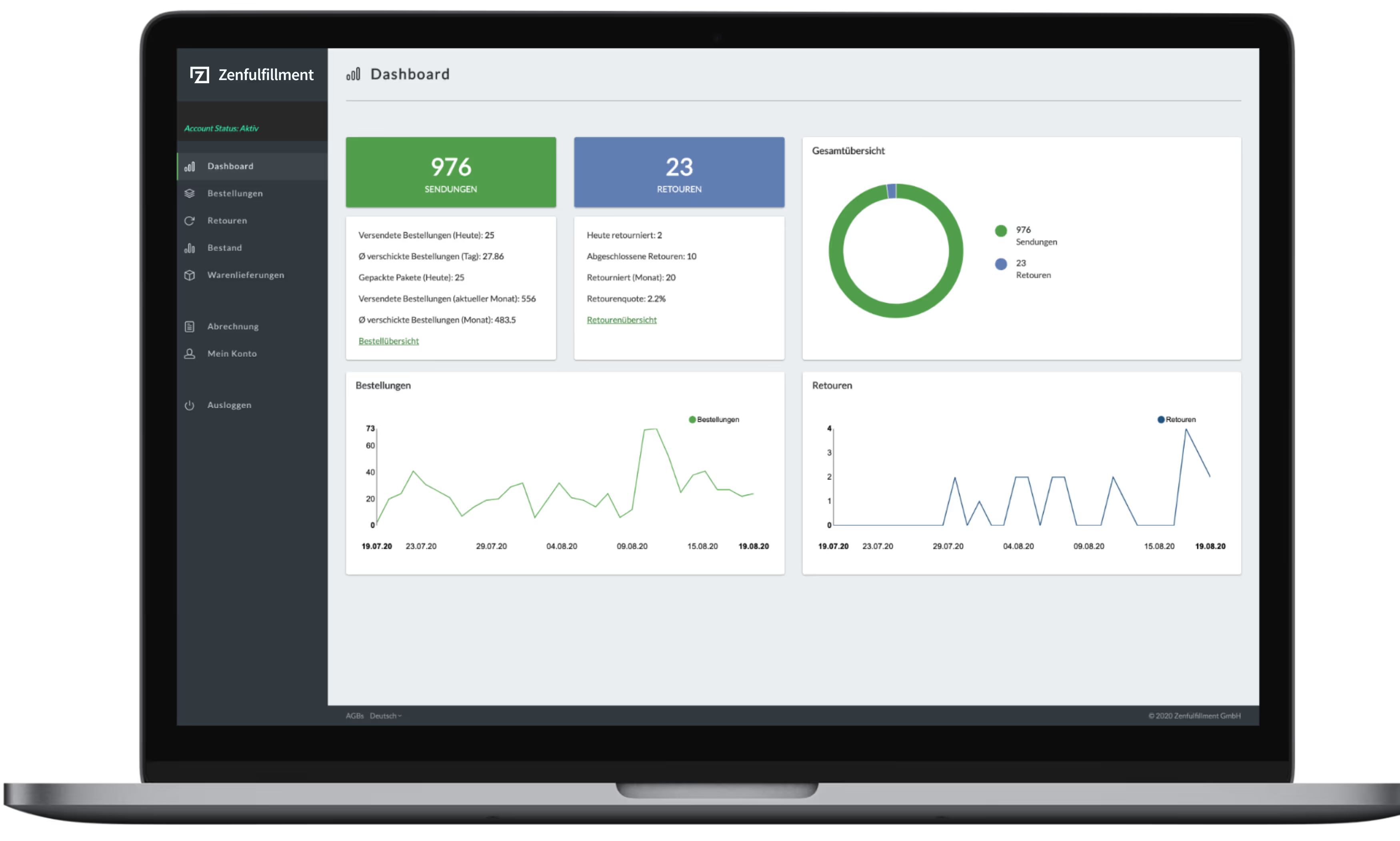
The e-commerce fulfillment definition makes it clear that reliable and professional work is important. Are you looking for a trustworthy fulfillment partner who meets the above criteria and can guarantee you fast shipping and market-competitive terms? Get a picture for yourself and be convinced by our benefits:

Free integration with 15+ shop and ERP systems
Access to the Zenfulfillment admin dashboard
No minimum shipment volumes or revenue requirements
No long-term contracts
Goods receipt & storage within a few business days
Real-time order and inventory sync
Address validation and correction
Automated pick & pack
Multi-location fulfillment
International shipping with 11+ carriers
Returns processing within 24–48h
Next-day delivery with Zenrush®
Cut-off time of 6:45 PM for same-day shipping
Custom returns portal
Monitoring and reporting
Operations Monday to Saturday, 5:30 AM to 11:30 PM
Enterprise-grade 24/7 security monitoring
And more...
Stress-free fulfillment
is just one click away!
E-commerce fulfillment covers every process that happens after a customer checks out in an online shop, so the order reaches them reliably. It starts with product storage, which is systematically organized and managed in real time. As soon as a customer places an order, the order is automatically sent to the fulfillment system. From there, picking begins — the items are gathered, checked, and packed. Shipping documents are then generated and the package is handed off to the right logistics partner.
But e-commerce fulfillment is much more than just shipping. Returns processing is also a core piece. Today’s customers expect easy return options that are transparent and handled quickly. Modern providers also offer value-added services like custom packaging, marketing inserts, or bundle building to lift the customer experience.
E-commerce fulfillment is therefore a holistic process that ties logistics, IT integration, and customer service together. The goal is to make order processing efficient, transparent, and scalable so merchants stay competitive and customers stay happy.
E-commerce fulfillment covers all the operational and organizational tasks needed to take an online order from the warehouse to the customer. The first key task is goods receipt and storage. Products arrive, get checked, are systematically stored, and recorded digitally in the inventory system. Merchants and customers benefit from transparent, real-time stock data.
The next key task is picking — pulling the ordered items together. Then comes packing, where protection, efficiency, and branding all play a role. Many providers also offer extras like personalized packaging or inserts that strengthen the brand experience.
Shipping is another core area. The package gets a shipping label and is handed to the right carrier. Another essential task is returns processing. Customers can send products back, which are checked at the fulfillment center, refurbished if needed, and put back into stock when possible.
Modern e-commerce fulfillment providers also handle additional services like customs clearance, batch management, or B2B shipping. That covers not just logistics but also the foundation for scalability and international expansion.
E-commerce fulfillment is a make-or-break factor for any online shop because it shapes how customers see the brand. In digital commerce, customers don’t just expect a wide product range — they expect fast, reliable, transparent delivery. Professional fulfillment makes sure orders are picked accurately, packed safely, and delivered on time. That lifts customer satisfaction, which feeds directly into repeat purchases and positive reviews.
Beyond the customer experience, efficiency matters too. Merchants who outsource fulfillment save time and resources by no longer handling storage, staffing, and shipping themselves. That frees them up to focus on marketing, product development, and strategic growth.
E-commerce fulfillment is also key to scalability. With a professional partner, shops can handle seasonal peaks like Black Friday or the holiday rush without investing in their own warehouse space or extra staff.
E-commerce fulfillment isn’t just a logistics task — it’s a strategic lever directly tied to customer satisfaction, brand image, and growth.
The difference between e-commerce fulfillment and shipping comes down to scope and depth. Shipping mainly means preparing and sending an order: packing the goods, applying the shipping label, and handing the package to the carrier. Shipping is one slice of logistics — the last step in the supply chain.
E-commerce fulfillment, on the other hand, covers the whole process that kicks off after checkout. That includes goods receipt, storage, inventory management, picking, packing, shipping, and returns management. Fulfillment goes well beyond shipping and also includes extras like custom packaging, inserts, batch management, or shop-system integrations with platforms like Shopify or WooCommerce.
While smaller merchants often handle shipping themselves, growing online shops increasingly rely on professional fulfillment providers. They deliver smooth operations, scalability, transparency, and speed.
E-commerce fulfillment is a far broader approach that supports the entire value chain in online commerce, while shipping covers just one piece of it.
Professional e-commerce fulfillment gives merchants benefits that go well beyond just processing orders. The biggest is efficiency. Outsourcing logistics to a specialist saves time and resources, since merchants no longer manage storage, picking, and shipping themselves. That recovered time can go into expanding the product range, marketing, or customer support.
Another key benefit is scalability. In-house logistics quickly hit their limits at seasonal peaks like Black Friday or the holidays, but professional fulfillment providers flex with demand. Merchants get capacity that grows with them, without investing in extra warehouse space or staff.
Customer satisfaction also plays a major role. Fast delivery times, transparent tracking, and professional returns handling lead to positive shopping experiences and more repeat orders.
The cost structure gets better too. Because fulfillment providers bundle large shipping volumes, they negotiate better carrier rates and pass those savings along to their customers.
E-commerce fulfillment gives merchants a clear competitive edge: faster processes, lower costs, and happier customers.
The e-commerce fulfillment process covers every step that happens after an order is placed, until the package reaches the customer. It starts with goods receipt and storage. Products arrive at the fulfillment center, get checked, entered into the system, and stored systematically. That gives merchants real-time visibility into their inventory.
As soon as a customer places an order in the online shop, the order is automatically sent to the fulfillment system. Picking begins next: the ordered items are located in the warehouse and pulled. Then comes packing, which can be functional and brand-strengthening at the same time. Many providers offer branding options like custom packaging or inserts to elevate the customer experience.
Next is shipping. The package gets a shipping label and is handed to the right carrier. Modern providers run multi-carrier setups to pick the best mix of speed and cost for every shipment.
Finally, returns processing plays an important role. Customers send products back, which are checked at the fulfillment center, refurbished, and restocked when possible.
The e-commerce fulfillment process is a continuous loop of storage, processing, shipping, and returns — powered by modern IT and automation.
Modern e-commerce fulfillment would be hard to imagine without advanced technology. At the center is digital inventory management, which delivers real-time data on stock, inbound goods, and open orders. Merchants stay on top of everything and can prevent shortages before they happen.
Another key technology is warehouse automation — barcode scanners, pick-by-light systems, even robots that pick and move products. These speed up processes and lower error rates. Smart packaging systems also make shipping more efficient and sustainable.
IT platforms like ZenOS at Zenfulfillment also play a central role. They connect shop systems like Shopify or WooCommerce directly to the warehouse for seamless data exchange. Built-in workflows let you set custom rules for shipping specific product groups or markets.
Real-time tracking is another important piece. With Track & Trace, both merchants and end customers can see where a package is at any time.
Modern fulfillment technology combines warehouse automation, IT integrations, data analytics, and tracking to make processes faster, more transparent, and more scalable.
Yes, e-commerce fulfillment works internationally, not just domestically — and for many growing online shops, it’s a key factor when entering new markets. Modern fulfillment providers run central or distributed warehouse locations strategically placed across Europe or worldwide. That shortens delivery times and lowers shipping costs because orders are processed closer to the end customer.
A key piece of international fulfillment is carrier integration. Professional providers work with multiple shipping companies, so they can pick the best mix of speed and cost for every region. Multi-carrier setups are especially effective at flexing with demand swings and keeping deliveries reliable.
International fulfillment also covers customs handling. Providers help merchants prepare the required documents and make sure packages move across borders compliantly and without delays.
For merchants, that means entering new markets without setting up their own infrastructure abroad. Customers get faster delivery times, transparent tracking, and a smooth returns process.
Picking the right e-commerce fulfillment provider is a strategic decision that shapes the long-term success of an online shop. Start by clearly defining your own requirements: product portfolio, expected order volume, target markets, and special needs like best-before-date management, B2B shipments, or custom packaging.
A core selection criterion is warehouse location strategy. Providers with centrally located fulfillment centers in Europe shorten delivery times and lower shipping costs. For internationally focused merchants, the provider also needs to handle cross-border logistics efficiently.
Technical integration matters a lot too. A modern fulfillment provider should plug smoothly into common shop systems like Shopify, WooCommerce, or Magento. Automated processes, real-time inventory views, and transparent tracking are essential.
Service and scalability should be on the list too. A good partner grows with the business and can serve both small startups and large merchants reliably.
E-commerce fulfillment isn’t one-size-fits-all — it takes a provider that understands your specific business goals and delivers solutions that fit them.
Zenfulfillment has become a leading provider in e-commerce fulfillment by combining modern technology, automation, and strategically placed warehouses. A central piece is the operating system ZenOS, which gives merchants full real-time visibility into stock, orders, and returns. Through integrations with shop systems like Shopify, WooCommerce, or Magento, orders flow automatically into the fulfillment process — no manual handoffs required.
Another standout is Zenrush, which delivers within 24 hours in Germany. That speed gives merchants a clear competitive edge and provably increases customer satisfaction. For international merchants, Zenfulfillment’s Central European Fulfillment (CEF) approach is an ideal base for fast, cost-efficient delivery across Europe.
Zenfulfillment also leans heavily on automation to speed up warehouse processes, minimize errors, and flex capacity. That’s paired with personal service — direct contacts at the warehouse who give you fast feedback through short communication paths.
Zenfulfillment combines technology, automation, speed, and customer proximity to make e-commerce fulfillment more efficient and competitive for merchants of any size.
