Code 128 is a widely used linear barcode symbology for machine-readable encoding of alphanumeric data. The name refers to the underlying character set: Code 128 can represent an extensive set of characters, making it suitable for identification numbers, references, and control information. Unlike two-dimensional codes (e.g., DataMatrix or QR Code), Code 128 is rendered as a one-dimensional barcode and is typically captured with laser scanners or camera-based reading systems.
In a logistics context, Code 128 is mainly used to uniquely identify shipments, load units, or documents. The code appears on labels, packages, delivery notes, or internal accompanying documents to transfer data into ERP, warehouse, and transport management systems. Thanks to the standardized format, processes in picking, goods receipt, sorting, and shipping can be mapped consistently.
Code 128 also plays a special role as a foundation for standardized application profiles, which define how specific data content is structured within the code. This means the barcode can carry not just a simple item or shipment number, but a defined data sequence that's interpreted the same way across different systems.
Code 128 is known for its high information density relative to printed length. Technically, the symbology is based on so-called code words with fixed bar-and-space structures. A complete code includes start and stop characters as well as a check element (checksum) that boosts read reliability and reduces misreads. This check information is evaluated during scanning and helps detect damaged or incompletely captured symbols.
Several character sets (commonly referred to as Code Set A, B, and C) are available for different data types. This means Code 128 can represent control characters and uppercase letters as well as mixed alphanumeric content. For purely numeric data, a special mode encodes digits in pairs and produces especially compact barcodes. In practice, suitable character sets are combined depending on the application and content to achieve a good balance of length, readability, and data volume.
Typical use cases in shipping and logistics include parcel and freight labels, internal warehouse markings, picking lists, and return slips. In many environments, Code 128 is part of labeling and scanning processes where the barcode serves as a key to retrieve records in the system (e.g., shipment status, recipient information, or storage location). Beyond the data code itself, print quality, contrast, module width, and the required quiet zone (clear area) also play a role since they significantly affect scannability.
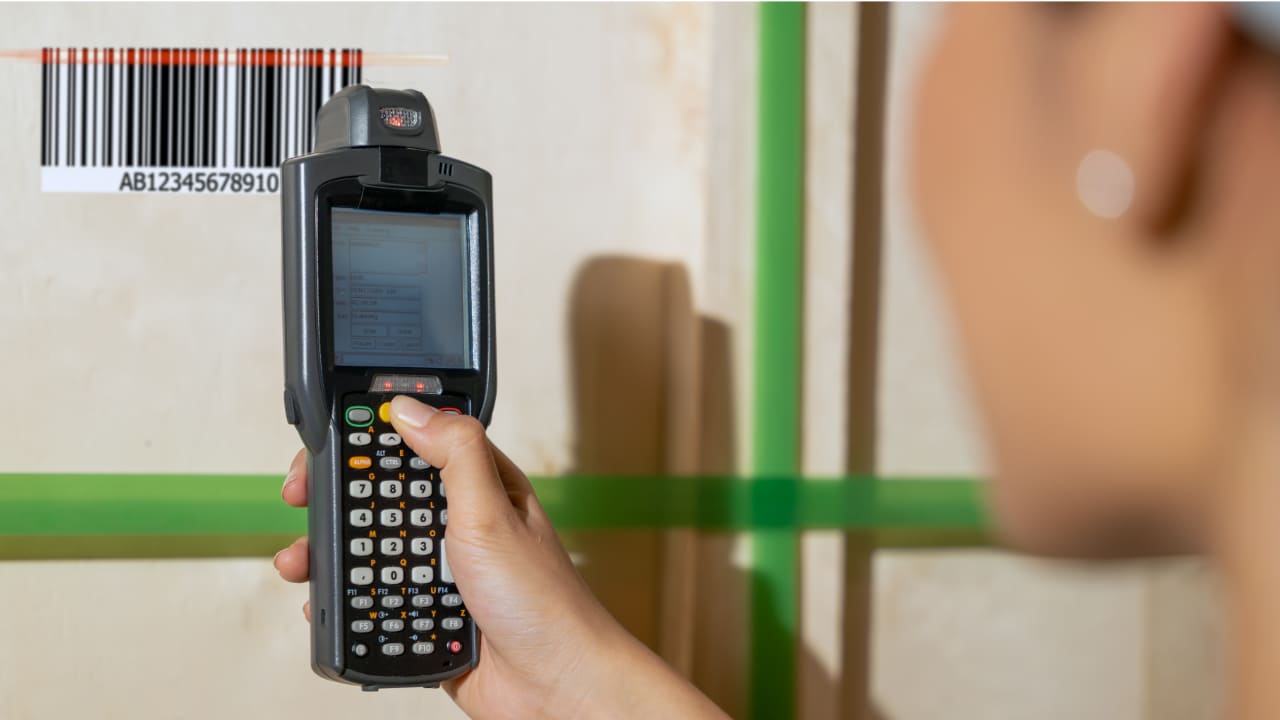
In logistics and E-Commerce, Code 128 supports end-to-end identification along the process chain. With high shipment volumes and short throughput times, fast and robust data capture is critical. Linear barcodes like Code 128 are well established in many sorting and conveyor systems because they can be read at high speed and are supported by a wide range of scanner hardware.
In shipping environments, Code 128 is often used for tracking and reference numbers that get scanned repeatedly during acceptance, transfer, and delivery. In the warehouse, Code 128 marks storage locations, containers, or internal order numbers to trigger postings in the warehouse management system. Thanks to its standardized structure, the symbology is also well suited for multi-stage service provider chains where different stations and systems access the same identifier.
Code 128 is often the natural choice when alphanumeric content needs to be reliably packed into limited space and the infrastructure is built for 1D scanning. Limitations show up when very large amounts of data have to fit on a small label or when especially high error tolerance is needed for heavily damaged labels — 2D codes are preferred for those cases. In many shipping and warehouse processes, however, Code 128 remains a pragmatic standard because it offers a strong combination of data capacity, read speed, and compatibility.
Barcode (1D): One-dimensional barcode that encodes data through bars and spaces and is read with classic scanners.
2D Code: Two-dimensional code (e.g., DataMatrix, QR Code) that encodes larger amounts of data in a small area, usually with higher error tolerance.
GS1-128: Application standard based on Code 128 with defined Application Identifiers (data identifiers) for transmitting structured content like GTIN, batch numbers, or serial numbers.
Check digit/checksum: Validation information used to verify a scanned code and reduce misreads.
Quiet zone: Clear area before and after the barcode required for reliable detection.
Print quality (barcode quality): Combination of contrast, edge quality, and module width that affects scannability and error rate.
Discover a variety of technical terms and in-depth explanations in our Zenfulfillment logistics lexicon.
Regardless of whether you are looking for the basic definitions of familiar terms or are interested in detailed explanations of complex topics — our logistics lexicon provides you with comprehensive information to help you To better understand the world of logistics and e-commerce.
Be inspired by practical examples, learn about new trends and discover helpful tips that will help you to continuously expand your knowledge in the logistics industry and stay up to date.


