
The term pallet jack refers to a low-level industrial truck used to lift, raise, and move palletized or similarly accessible load units. In day-to-day warehouse work, the manually operated pallet jack is often called a „hand pallet truck“ or, in German, an „Ameise.“ The German nickname has become a generic name, even though it historically traces back to brand and product names of individual manufacturers. In a glossary context, it should be understood as a common colloquial synonym for the pallet jack.
Pallet jacks are among the most basic in-house transport tools. They're mainly used for short-distance transport and for positioning pallets in goods receipt, picking areas, buffer zones, or at loading docks. Unlike more complex industrial trucks like forklifts, pallet jacks generally operate close to the ground, have a relatively compact form, and need only minimal infrastructure — mainly load-bearing, ideally even floors.
The basic distinction is between manual pallet jacks (hydraulic lifting via a tiller pump) and electric pallet jacks (drive and/or lift powered electrically). Both versions handle similar tasks but differ in performance, ergonomics, speed, range, and typical use profile. In many operations, multiple variants coexist to cover different goods flows and floor conditions.
A pallet jack typically consists of a tiller for steering, a hydraulic unit for lifting, two fork tines to slide under the pallet, steering wheels, and load wheels under the fork tips. On manual pallet jacks, the hydraulics are operated by pumping the tiller; lowering happens via a valve. Electric pallet jacks come with a drive motor, an electric lift motor, or both, depending on the design.
Key characteristics come from the combination of fork geometry, load capacity, and wheel design. Fork width and length need to match the load unit (e.g., Euro pallet or industrial pallet). Load capacity on standard equipment often falls in the range of several tons, with actual safe usage influenced by load center, equipment condition, and floor surface. Wheel materials (e.g., polyurethane, nylon, or rubber) affect rolling behavior, noise, floor protection, and rolling resistance.
Typical use cases for the pallet jack include moving pallets at goods receipt and dispatch, replenishing goods at pack and shipping stations, and shifting pallets within block or rack storage areas — as long as the pallets are accessible at floor level. In tight spaces, on truck loading platforms, or in areas with frequently changing positions, easy handling is seen as an advantage. Limits show up mainly with uneven floors, long distances, high throughput volumes, or the need to lift loads to greater heights, where other industrial trucks are more suitable.
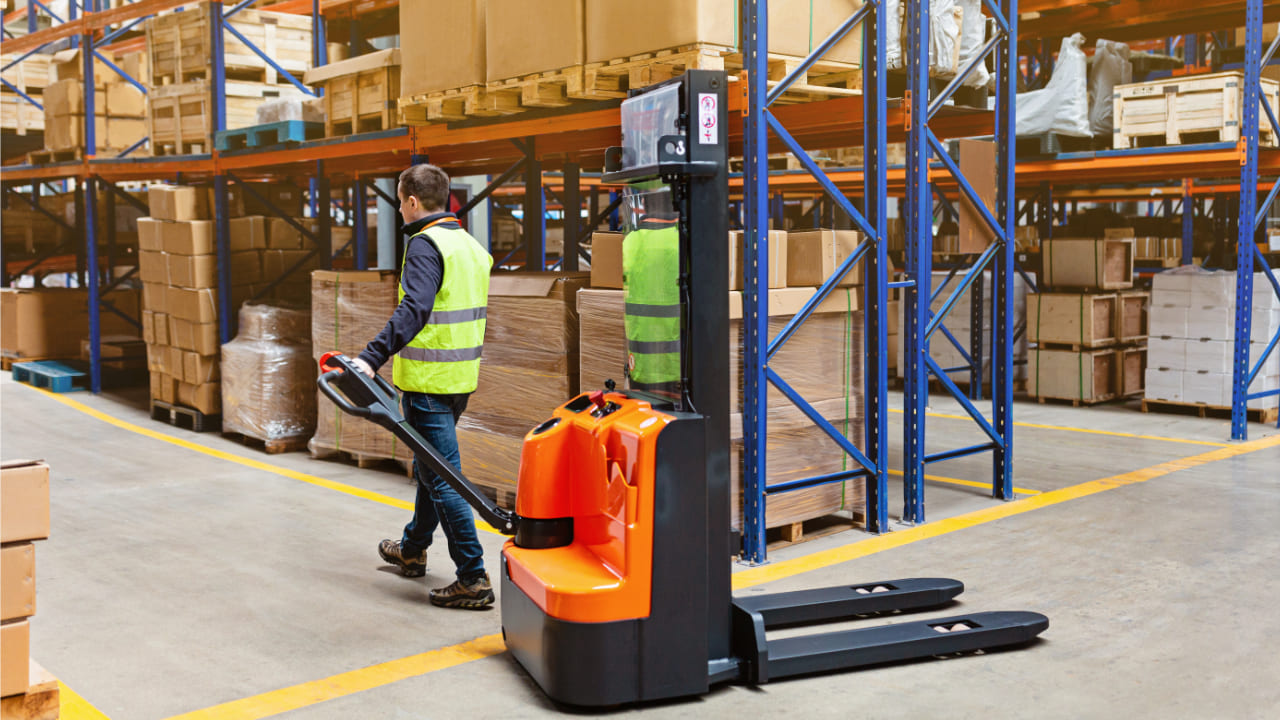
In day-to-day logistics, the pallet jack serves as a key bridge between storage, picking, and loading. In shipping and fulfillment environments, it's often used to move pallets of replenishment goods, shift shipping pallets, and pre-stage at handover points. Many e-commerce processes are characterized by high SKU variety and short lead times, so a quickly available, easy-to-use transport tool for short-notice material moves is often a fixed part of operations.
Even in smaller warehouse and shipping setups, the pallet jack is often the primary industrial truck because it has minimal training, space, and infrastructure requirements and offers flexible use. In larger logistics centers, pallet jacks and electric low-lift trucks complement conveyor technology by covering edge cases, enabling buffer moves, or shifting load units where stationary equipment isn't economical or available. In this role, the pallet jack indirectly affects KPIs like throughput, travel time, and material flow stability — without itself being an IT or system element.
From a workplace safety and process quality perspective, the „Ameise“ also matters because it's often used in mixed-traffic areas — at gates, in pack zones, or in transitions between warehouse and production. The specific version (manual or electric) can affect ergonomics, noise level, and suitability for certain floor conditions. For standardized pallet processes, the pallet jack remains a widely used tool that has established itself as basic equipment in many logistics and shipping environments.
Industrial truck: umbrella term for in-house vehicles used to move goods, including pallet jacks, forklifts, and tugger tractors.
Low-lift pallet truck: electrically or manually operated pallet jack that can lift loads close to the ground; often used as an electric variant in continuous operation.
High-lift pallet truck: industrial truck that can lift pallets higher — for example, to enable putaway in lower rack levels.
Forklift: motorized industrial truck with a lifting mast for greater lift heights and higher throughput.
Euro pallet: standardized wooden pallet (EPAL); the most common load unit in European general cargo and shipping environments.
Load center: position of the load's center of gravity; affects permissible load capacity and stability during transport.
Discover a variety of technical terms and in-depth explanations in our Zenfulfillment logistics lexicon.
Regardless of whether you are looking for the basic definitions of familiar terms or are interested in detailed explanations of complex topics — our logistics lexicon provides you with comprehensive information to help you To better understand the world of logistics and e-commerce.
Be inspired by practical examples, learn about new trends and discover helpful tips that will help you to continuously expand your knowledge in the logistics industry and stay up to date.


