
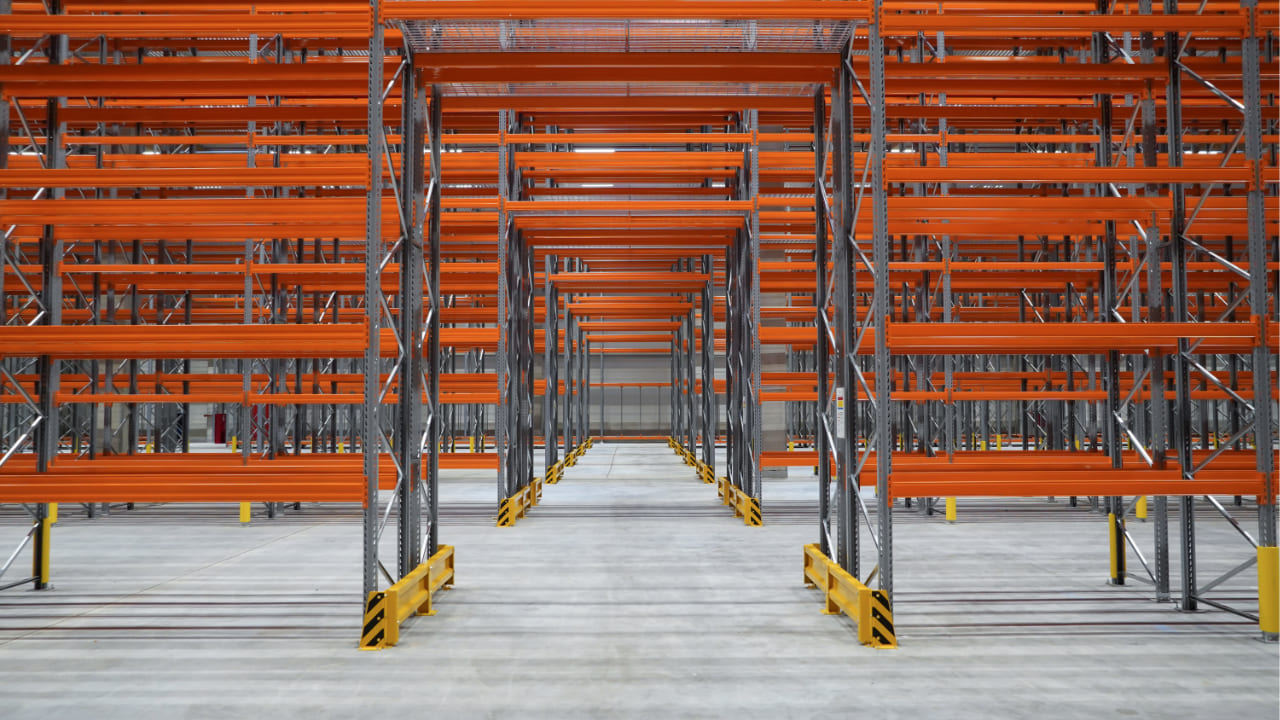
A pallet rack is a racking system for storing palletized loads — mainly Euro pallets, industrial pallets, or special load carriers. It belongs to the family of heavy-duty racks and is used in warehouses, distribution centers, and production and shipping areas to present goods on multiple levels in an organized, load-bearing, and space-efficient way. Unlike shelving racks, the dimensions are designed for heavy loads and handling with industrial trucks like forklifts or reach trucks.
Pallet racks are typically used wherever goods are handled not as individual items but as bundled units (e.g., cartons on a pallet, mesh boxes, or containers on a pallet). In logistics structures, they're a central element of warehouse equipment because they combine storage capacity with accessibility: depending on the design, pallets can be accessed directly or stored in compacted lanes.
Classification is often based on the access principle and storage strategy. In direct-access systems, fast availability of individual pallets takes priority; in compacting systems, space requirements are reduced while access can be more strongly influenced by sequence rules (e.g., FIFO/LIFO). This means the pallet rack is closely tied to processes like goods receipt, replenishment, pick-face supply, and goods issue.
The basic structure of a pallet rack consists of vertical frames (uprights with diagonal and horizontal bracing) and horizontal beams on which the pallet levels rest. Additional bracing, base plates, impact protection elements, and various supports (e.g., wire decks or load profiles) can be added to support load capacity and operational safety. The height of storage levels is usually adjusted via a hole pattern on the uprights, so the rack can be adapted to pallet heights and load units.
Key characteristics include the defined shelf load (permitted load per storage level), the bay load (permitted load per rack bay), and the design for the available handling equipment and aisle widths. Load capacity and stability are determined by material thickness, profile geometry, and floor anchoring. In practice, safety aspects also play an important role — for example, avoiding impact damage, complying with load signs, and clearly marking permissible loads.
Different designs exist depending on the application. The classic single-deep pallet rack with direct access is common, where each pallet can be reached independently. For higher storage density, variants like drive-in or drive-through racks, pallet flow racks (with roller beds), or shuttle-based channel storage are used. These forms influence storage strategy, access speed, and suitability for certain item structures (e.g., many items in low quantities versus few items in high quantities).
Use cases range from raw material and production supply to buffer storage and finished-goods storage in shipping. In e-commerce, pallet racks are often used in combination with picking zones: pallets serve as reserves (replenishment), while piece or carton picking happens in separate areas. Pallet racks are also common in temperature-controlled environments (chilled or frozen), with material selection, corrosion protection, and operating concepts adapted to the ambient conditions.
Pallet racks shape the performance of many warehouses because they directly affect the central targets of capacity, access time, and process stability. High capacity comes from vertical use of the building height; access time depends on rack type, aisle concept, and the number of movements per put-away and retrieval. In warehouses with high item variety, direct pallet access supports flexibility, while in high-volume, single-SKU areas, compacting systems can deliver economic advantages.
In daily operations, pallet racks influence material flows between goods receipt, put-away, replenishment, and goods issue. Pallets are often used as a standard load unit to consolidate transport, protect goods, and standardize interfaces between suppliers, warehouses, and carriers. This makes the pallet rack a hub between storage and shipping: it serves as a buffer, as reserve stock, and as a source of replenishment for downstream picking or packing processes.
Inventory management and system integration also matter. Storage locations in pallet racks are mapped in warehouse management systems (WMS) or inventory software as locations, typically with information about level, slot, aisle, and side. This supports clear assignment of pallet IDs, batches, best-before dates, or serial numbers, provided the goods are labeled accordingly. In automation-near environments, pallet racks are also used as an interface to conveyor technology, pallet lanes, or automated storage and retrieval solutions, where the mechanical execution and the tolerances of the load units play a larger role.
Discover a variety of technical terms and in-depth explanations in our Zenfulfillment logistics lexicon.
Regardless of whether you are looking for the basic definitions of familiar terms or are interested in detailed explanations of complex topics — our logistics lexicon provides you with comprehensive information to help you To better understand the world of logistics and e-commerce.
Be inspired by practical examples, learn about new trends and discover helpful tips that will help you to continuously expand your knowledge in the logistics industry and stay up to date.


