
Road tolls are fees charged for the use of certain transport routes and infrastructure. Depending on the country and system, this includes highways, expressways, tunnels, bridges, or inner-city zones. The aim of tolls is typically to finance, expand, or maintain transport infrastructure, as well as to manage traffic flows. In many systems, tolls are also used as an instrument to partially price the external costs of traffic — such as emissions, noise, or congestion.
In the logistics context, road tolls are treated as part of variable transport costs. They are often based on mileage or usage, which means they affect costs per tour, per shipment, or per ton-kilometer. The specific design depends on national regulations, the vehicle class involved, and the type of route used. While some countries opt for a time-based fee (e.g., a vignette), others charge fees by distance or section.
Toll systems primarily affect freight transport, because trucks are often more strongly subject to toll logic than passenger cars due to vehicle weight, axle count, and mileage. In many cases, thresholds apply (e.g., above a certain gross vehicle weight) at which vehicles become subject to tolls. At the same time, exceptions, exemptions, or reductions exist, for example for certain vehicle types, emergency vehicles, or depending on drive and emission class.
The structure of road tolls is shaped by several factors, which can be combined depending on the operator and legal framework. Common features include differentiation by vehicle parameters (e.g., weight class, axles, emission standard) and billing based on the actual distance traveled. There are also systems with flat-rate periods, where usage is paid for a defined duration. In urban areas, zone- or event-based models also occur, for example for entering specific city areas.
Technically, road tolls are collected through different methods. Alongside traditional toll booths, electronic systems exist that rely on on-board units, satellite-based positioning, mobile data, or camera-based license plate recognition. These systems enable automated capture and billing, reduce stops, and support more granular tariff logic. At the same time, requirements arise for data quality, traceability, and compliant documentation of charges.
Typical use cases for road tolls range from inter-regional transit routes to particularly cost-intensive structures like tunnels or bridges. In practice, tolls can be part of state infrastructure policy or part of privately operated concessions, where an operator refinances the investment through usage fees. In cross-border supply chains, the heterogeneity of systems also plays a role: tariffs, billing logic, and proof requirements can differ significantly between countries and routes.
For cost impact, operational conditions matter alongside the nominal rate. These include route selection, detours to avoid tolls, the predictability of costs across recurring lanes, and possible surcharges or relief through certain vehicle configurations. Especially with high transport frequency, small tariff differences can have noticeable effects on a network's overall costs.
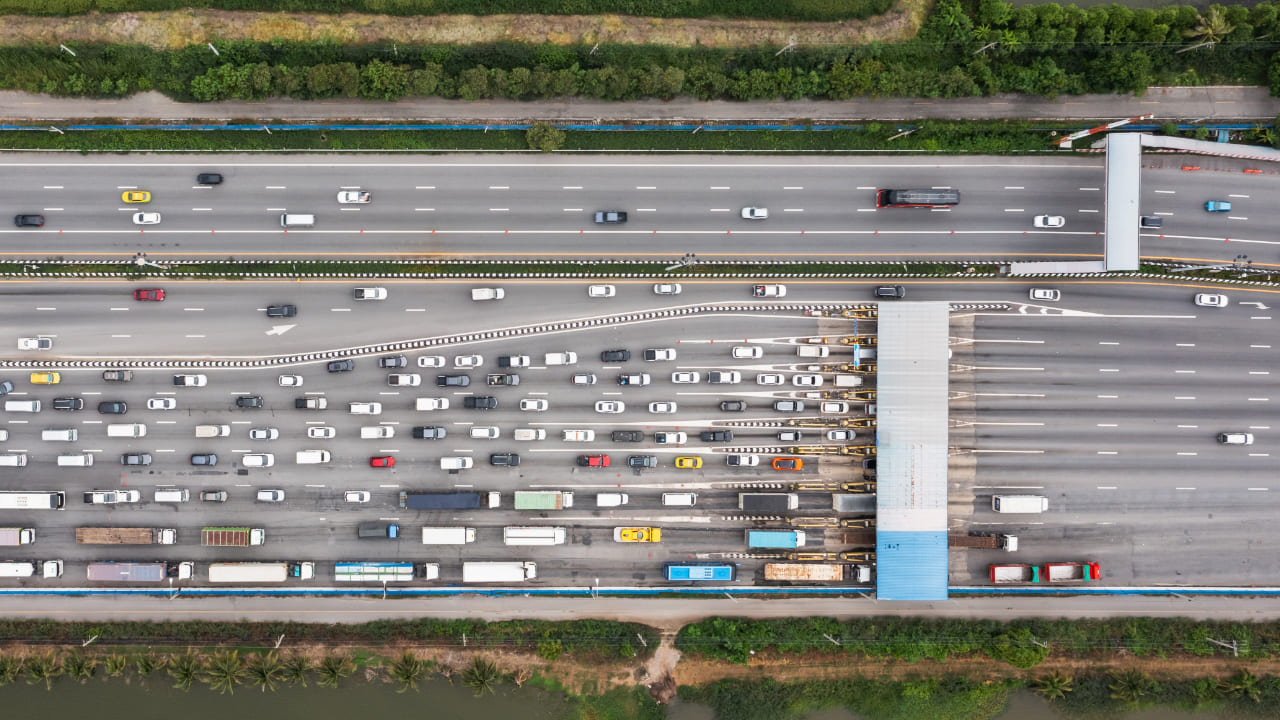
In logistics and shipping, road tolls act as a direct cost driver in road freight transport. They influence freight rates, tour calculations, and the profitability of lanes. In transport tenders and price agreements, toll costs are often listed separately or integrated into compensation through surcharge models. This creates an interface between operational billing (actual mileage) and the commercial pass-through of costs along the supply chain.
For distribution networks, especially in e-commerce, road tolls can shape site and route logic. With high shipment density and tight delivery windows, service quality usually takes priority, while toll costs are optimized as part of the overall cost structure. In other cases, such as inter-regional line-haul, tolls can move into sharper focus because mileage is predictable and economies of scale arise across repeated lanes. Differentiation by emission class can also create economic incentives to modernize vehicle fleets, provided the fee structure offers corresponding advantages.
Tolls also play a role in fulfillment: they must be correctly captured, posted, and in some cases documented in an audit-proof manner. Discrepancies can arise from incorrect vehicle classification, unconsidered route sections, or differing national regulations. In complex transport chains with subcontractors, toll costs must be transparently attributable in order to cleanly evaluate cost centers, lanes, or customer segments.
From a supply chain perspective, tolls are also a framework factor for choosing the transport mode. Where tolls and operating costs rise in road transport, the relative attractiveness of intermodal transport or alternative routes can increase, provided infrastructure, lead times, and handling effort allow for it. The actual impact depends on market conditions, capacity, and requirements for flexibility and delivery quality.
Vignette: Time-based usage fee that grants access to certain roads for a defined period (e.g., days, weeks, years).
Road Pricing: Umbrella term for usage-based pricing of roads, often aimed at traffic management or financing.
Discover a variety of technical terms and in-depth explanations in our Zenfulfillment logistics lexicon.
Regardless of whether you are looking for the basic definitions of familiar terms or are interested in detailed explanations of complex topics — our logistics lexicon provides you with comprehensive information to help you To better understand the world of logistics and e-commerce.
Be inspired by practical examples, learn about new trends and discover helpful tips that will help you to continuously expand your knowledge in the logistics industry and stay up to date.


