
Warehouse types refer to the different forms warehouses can take, distinguished by purpose, function, structural and technical setup, and organizational criteria. In logistics and shipping, the term describes less a single warehouse and more a framework for classifying warehouse locations and storage zones within supply chains. Warehouse types emerge from concrete needs: buffering inventory, supplying production processes, fulfilling customer orders quickly, or storing goods safely under specific conditions (e.g., temperature-controlled).
The classification by warehouse type is closely tied to the warehouse's role in the material and goods flow. A warehouse can act as an interface between procurement and production, as a hub for regional distribution, or as a central inventory pool serving multiple sales channels. Warehouse types can also be described by their degree of specialization — for example, focusing on specific product groups (hazardous goods, food), specific process logics (picking, cross-docking), or specific customer expectations (same-day/next-day availability in e-commerce).
In practice, warehouse types are often combined: one site can serve as a central warehouse and contain different storage zones inside (e.g., pallet storage, small parts storage, returns area). Differentiating warehouse types supports planning, costing, process design, safety requirements, and the choice of suitable storage and conveyor technology.
Warehouse types can be structured along several feature groups. A common view focuses on the logistics purpose: this includes procurement or raw material warehouses for production supply, production or interim warehouses to decouple manufacturing stages, and sales and distribution warehouses to ensure availability for retail and end customers. In a shipping context, returns warehouses and service areas (e.g., spare parts warehouses) appear as standalone functions, because returns and after-sales processes have their own inventory and quality requirements.
Another structural feature is the position in the network. A central warehouse consolidates inventory for a region or country and supplies stores, partners, or fulfillment sites. Regional warehouses and delivery warehouses sit closer to the recipient, cutting transport times but typically running with a narrower assortment and smaller safety stocks. In omnichannel setups, stores can also act as "mini warehouses" with shipping functions, where storage, sales floor, and fulfillment overlap organizationally.
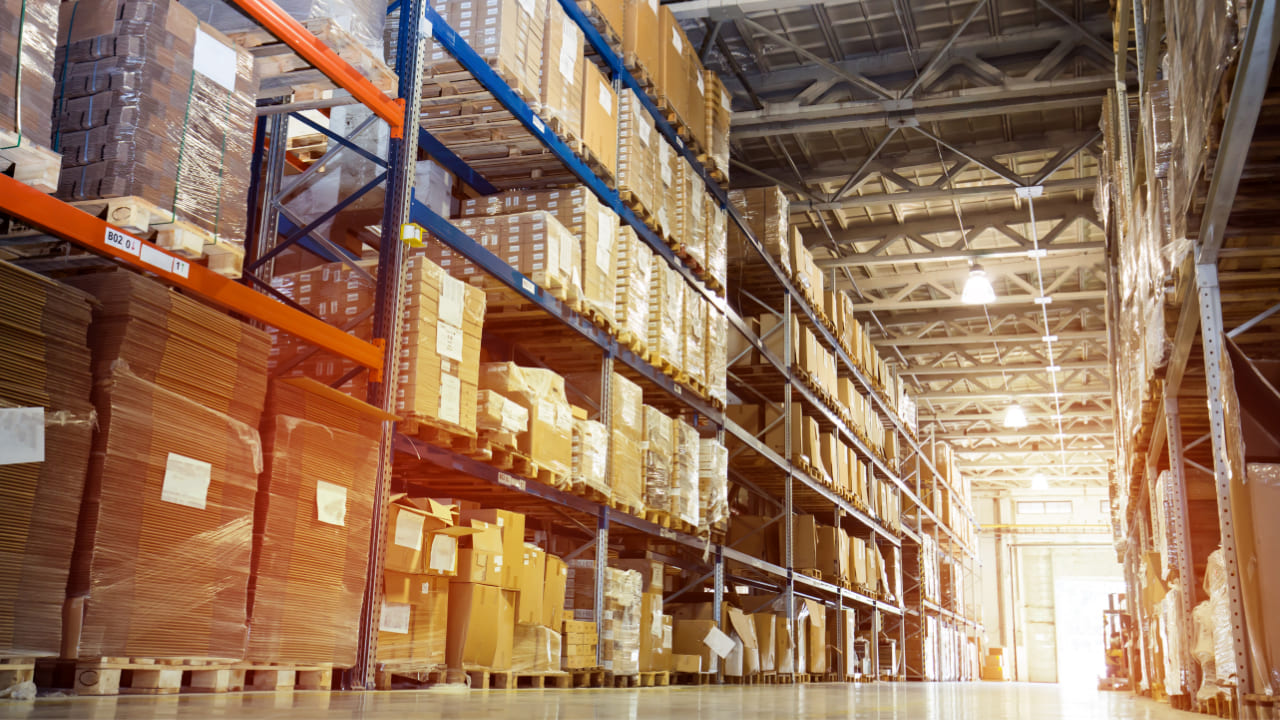
Technically, warehouse types are shaped by storage systems and warehouse technology. Typical forms include block storage (floor-based, often for homogeneous palletized goods), rack storage (structured storage with direct access), automated small parts storage or shuttle systems (high throughput, high space efficiency), and special forms like silos or tank storage. The degree of automation also matters: manual warehouses lean on people-driven processes, semi-automated warehouses combine technology (e.g., conveyor systems, pick-by systems) with manual operation, and fully automated warehouses integrate storage and picking processes largely under system control.
The storage units and the assortment to be stored also affect the warehouse type. Pallet warehouses are designed for standardized load units and high weights, while small parts warehouses need finely structured storage locations to manage a wide product range efficiently. For temperature- and quality-sensitive goods, refrigerated and freezer warehouses show up as their own warehouse types; for hazardous materials, hazardous goods warehouses come with specific fire and environmental protection requirements. In these cases, product safety largely determines layout, permits, and operations.
In a shipping and e-commerce context, warehouse types tied to process logic are also relevant. Fulfillment warehouses combine goods receipt, putaway, picking, packing, and shipping in an integrated workflow. Cross-docking-oriented hubs reduce storage time by routing goods directly to outbound shipments after receipt. The focus shifts from inventory holding to throughput and timing, while the storage function as a buffer is intentionally kept small.
The choice and design of warehouse types affects cost, service level, and risk across supply chains. Warehousing ties up capital and floor space, but boosts availability when procurement variability, production interruptions, or demand peaks hit. Depending on the warehouse type, inventory is either centralized or pushed closer to the customer. Centralized concepts can reduce inventory and standardize processes, while decentralized warehouse types typically speed up delivery and shorten transport distances.
For e-commerce, the warehouse type is especially tightly linked to customer expectations on lead time, availability, and transparency. High product variety, lots of small orders, and frequent returns favor warehouse types with picking-optimized layout, clear inventory tracking, and scalable process zones (e.g., separate areas for fast movers, slow movers, and returns). In this setting, layout, slotting strategy, and degree of automation directly affect throughput times and error rates. At the same time, IT-driven control becomes more demanding — typically through warehouse management systems that support putaway strategies, inventory accuracy, and shipping prioritization.
In classic B2B settings, the warehouse type also remains a key lever: spare parts and service concepts need high availability against often irregular demand, while production warehouses prioritize supply security and stable material provisioning. Legal and quality frameworks also shape the warehouse type — for hazardous materials, food, or pharmaceutical products, traceability, batch tracking, and defined storage conditions are not just efficiency factors but often a prerequisite for compliance and audit readiness.
Overall, the system of warehouse types frames the warehouse not just as a building or area, but as a deliberately designed functional unit within procurement, production, distribution, and reverse logistics. The right warehouse type results from a combination of network role, assortment, volume profile, service requirements, and process logic.
Discover a variety of technical terms and in-depth explanations in our Zenfulfillment logistics lexicon.
Regardless of whether you are looking for the basic definitions of familiar terms or are interested in detailed explanations of complex topics — our logistics lexicon provides you with comprehensive information to help you To better understand the world of logistics and e-commerce.
Be inspired by practical examples, learn about new trends and discover helpful tips that will help you to continuously expand your knowledge in the logistics industry and stay up to date.


