
Materials handling refers to all the technical equipment used to move, lift, feed, buffer, or distribute goods, load carriers, or materials within an operation. It's a core part of intralogistics and connects individual process steps such as goods receipt, storage, picking, packing, and shipping. Unlike external transport (e.g. forwarding companies, parcel carriers), materials handling focuses on movement inside buildings, on company premises, or along defined material flows.
Materials handling can be classified by both the type of movement and how it's organized. Common distinctions are between continuous conveying (steady material flow, e.g. via belt conveyors) and non-continuous conveying (discrete transport units, e.g. with industrial trucks). Systems are also broken down into manual, semi-automated, and fully automated solutions. The choice depends on the type of goods, throughput, required flexibility, safety requirements, and the spatial layout of the facility.
In a logistics context, materials handling isn't just a "means of transport" — it's an integral part of layout, process design, and IT-driven control. In modern facilities, it's often paired with warehouse and material-flow computers and identification technologies to uniquely assign shipments, totes, or pallets and keep their movements traceable.
Materials handling systems usually consist of mechanical components (e.g. rollers, belts, chains, frames), drives and power units, sensors, and control technology. Add to that interfaces to storage equipment and workstations. Typical features include defined conveyor paths, standardized handover points, and a layout matched to the load carriers in use. Materials handling is often designed for specific transport objects — for example, cartons, totes, hanging garments, or pallets.
Common system types include belt and roller conveyors, chain conveyors, vertical conveyors (e.g. lifts), sorters, overhead monorails, and automated guided vehicle (AGV) systems. These systems can be linked together within a single material flow, so goods are routed through defined stations from inbound to ready-to-ship. In many cases, buffer sections are added to absorb cycle-time differences between process steps.
Use cases exist in nearly every industry that handles physical goods. In distribution centers, materials handling speeds up onward transport of packages and connects picking and packing zones. In production environments, it supports material supply to lines and workstations. In groupage logistics, it's tightly linked with sorting and distribution processes. In temperature-controlled environments (e.g. food), materials handling is also used, with materials and design adapted to hygiene standards and ambient conditions.
Typical goals are reducing manual movement, increasing throughput, smoothing out process quality, and adding transparency to the material flow. At the same time, requirements emerge around availability, maintenance, fault management, and safe interaction between people and equipment, especially in mixed environments with automated runs and manual workstations.
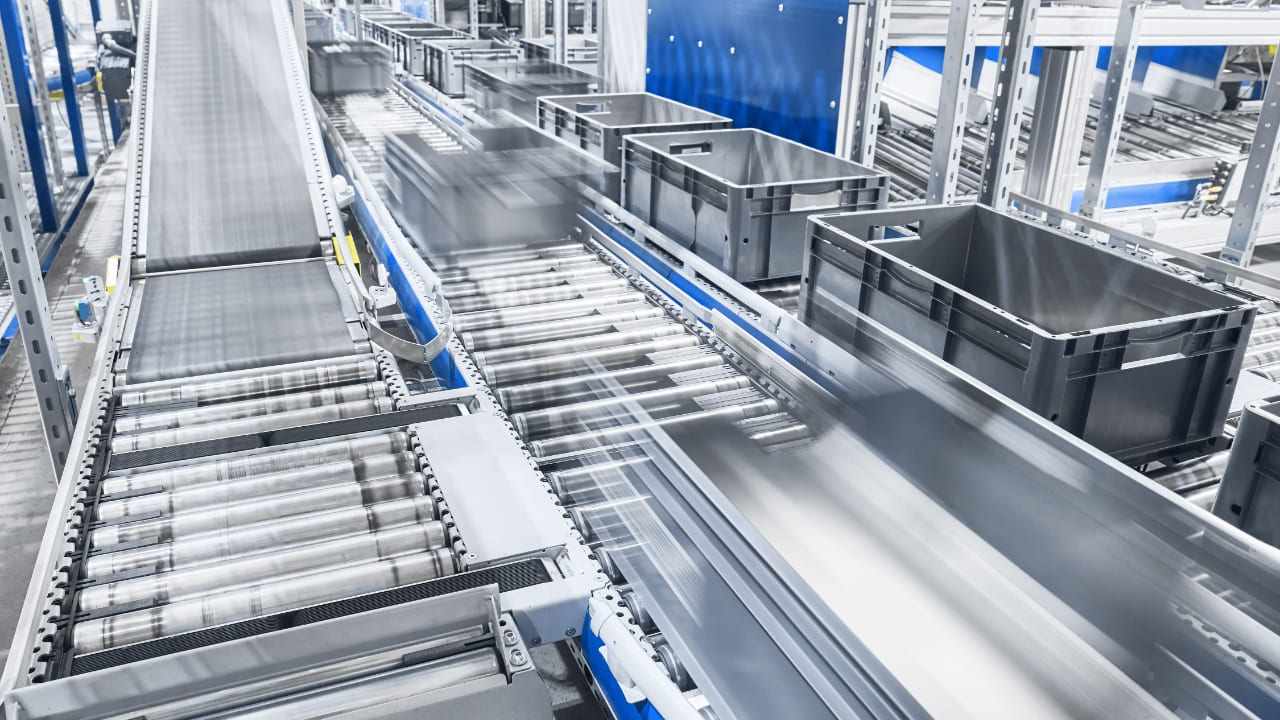
In logistics and e-commerce, materials handling matters in particular because high shipment volumes, short delivery windows, and steep order peaks shape the operating reality. It provides the physical backbone for moving large numbers of items and parcels reliably through the warehouse and supplying processing stations. Combined with sorting technology, shipments can be grouped by carrier, route, destination country, or cut-off time, which speeds up shipping operations.
The design of materials handling has a major impact on layout and process flow. Conveyor lines can decouple work areas by bundling material flows and standardizing handovers. At the same time, they can limit flexibility when item mix, package sizes, or throughput profiles change significantly. That's why materials handling in e-commerce is often planned in a modular way — with extendable lines, variable handover points, or adjustable sorting logic. In automated warehouses, it's also tightly tied to identification and control systems: barcodes or RFID make sure totes and cartons are diverted, buffered, or routed to the right pack station.
Materials handling matters from a business perspective too. It usually carries a high share of capex and maintenance costs, but it can also reduce process cost per shipment through higher throughput, lower error rates, and more predictable operations. System availability plays a central role, since disruptions ripple immediately into downstream areas. In practice, redundancies, defined bypass routes, or buffer zones are used to keep operations stable during partial outages.
Material Flow: The sum of all movements of materials and goods within a system; materials handling provides the physical infrastructure for it.
Discover a variety of technical terms and in-depth explanations in our Zenfulfillment logistics lexicon.
Regardless of whether you are looking for the basic definitions of familiar terms or are interested in detailed explanations of complex topics — our logistics lexicon provides you with comprehensive information to help you To better understand the world of logistics and e-commerce.
Be inspired by practical examples, learn about new trends and discover helpful tips that will help you to continuously expand your knowledge in the logistics industry and stay up to date.


